
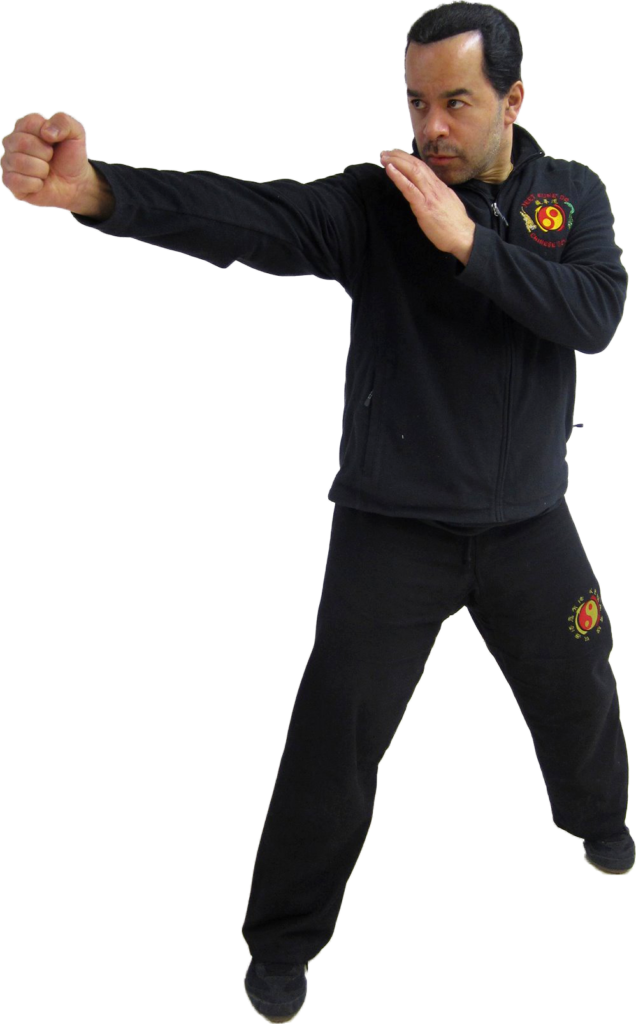
By sifu Richard Torres
First published in 'inside kung fu' , August 1998.
With the passing of Bruce Lee July 20, 1973, many inquiries have been made about his unique art of jeet kune do. Twenty-six years have passed since that dreadful day and yet many questions remain unanswered. This article will attempt to answer some of the questions which continue to cause problems.
Though some will interpret this article as critical, it is merely meant to educate. The true objective is to assist the openminded martial artist in understanding Bruce Lee’s intentions in creating jeet kune do. There is a new generation of martial art students today who know nothing about Bruce Lee’s JKD. This article will inform anyone else who wishes to know the true meaning of this unique martial art system.
First, you may be asking with what authority or knowledge I write this article. My experience with JKD goes back to 1973, when I began to thoroughly research and experiment with this unique art. Following Bruce Lee’s advice in his early articles, I broke away from traditional martial arts and began training with full contact sparring, utilizing equipment such as focus mitts, heavybags and kicking shields.
Wet And Wild
In regard to training, Bruce Lee responded to a magazine reader’s letter by writing, „Hang a heavy bag in your basement and use your legs as you would your hands. Of course, practice as much sparring as you can. You have to get wet in order to learn to swim.” So I „got into the water” and began experiencing martial arts instead of practicing prearranged situations.
My actual first-hand training into jeet kune do with an instructor began in the 1980s with what is now known as the „JKD concept method”. Though I was practicing this concept method (since it was the only available means to learn some of Bruce Lee’s theories first-hand), it barely resembled the JKD art I had experimented with, researched, and experienced back in the 1970s. The very reason was because I found myself swinging escrima sticks, practicing kali movements and drilling in Thai boxing techniques that were not found in Bruce Lee’s JKD.
The jeet kune do I had researched and experimented with in the early 1970s had none of these arts in its arsenal. My research taught me the three main martial art systems Bruce Lee used to develop his jeet kune do were wing chun, fencing and boxing. In fact, Bruce Lee wrote a letter in 1965 to his pupil James Lee, who was teaching for Bruce in Oakland, Calif., in which he states, „I’m having a gung-fu system drawn up. This system is a combination of chiefly wing chun, fencing and boxing. As for practice, I have other ways of training. I’ll have them written down when it is finished. Boy, it will be it!”
To find someone who was actually teaching Bruce Lee’s jeet kune do was no easy task, since many of his L.A. students had evolved on their own into other styles of combat using the JKD philosophy and were concentrating more on these styles than in Bruce Lee’s original techniques. Many of these instructors hit the seminar circuit in which jeet kune do or Jun Fan gung-fu would be advertised, but the JKD techniques taught were only a small fraction of a larger concept curriculum of different styles of combat.
The participants of these seminars were accumulating a mixture of different-structured martial art styles and techniques. There is nothing wrong in learning this way if this is your preference. But I desired to learn the philosophy and structured foundation of Bruce Lee’s jeet kune do techniques, and unfortunately there was no one teaching it. Or so I thought.
I met Ted Wong in 1990 when I attended the Bruce Lee 50th Anniversary Banquet Dinner in Los Angeles. At this event I also met Linda Lee, Brandon Lee, many of Bruce Lee’s students and friends. Ted Wong was just beginning to teach to the general public. Previously, he had trained with Bruce Lee from 1967-1971, when Bruce went to Hong Kong to make movies. Wong stayed away from the public limelight and continued training privately on his own. But when he saw the physical structure of Bruce Lee’s jeet kune do disappearing, he went public and began to spread the teachings he had personally learned from Bruce Lee himself.
He is quoted as saying, „You have to preserve his „in at some point to prevent it from completely disappearing. So right or wrong, that’s my desire to preserve Bruce’s jeet kune do. I’m doing it to honor him.”
It is important to note that Ted Wong is one of only two people to receive a jeet kune do certificate directly from Bruce Lee. The other person is Dan Inosanto. After six months of private training with Bruce Lee (June, 1967-December, 1967) Wong received second rank in jeet kune do: The following year, Bruce Lee did away with all ranking structure in JKD. Wong continued training privately with Bruce Lee for another four years. One can only imagine which rank )eve) he would have achieved had Bruce Lee continued ranking in JKD.
The Birth Of JKD
Training with Ted Wong, I learned about Bruce Lee’s teachings in creating jeet kune do. But more than )earning the philosophical aspects, I learned that jeet kune do does have a structure and a foundation from which to build upon and evolve. There are many exclusive techniques and drills found in this system including the phasic-bent-knee fighting stance, the lead straight thrust power punch, the five ways of attack, the JKD footwork, the lead legs hand attacking tools, the strong side forward theory, the intercepting punch or kick application and drills, the study and application of kinesthetic perception, the broken rhythm/half-beat training, the economic tight structure in attack and defense, the JKD directness application, the JKD in-fighting strategies, a))-out full-contact sparring, balance-in-motion training, combat flowing, simplified trapping hand techniques and bridging-the-gap drills can be found exclusively and collectively only in Bruce Lee’s jeet kune do. Many of the apparatus contact training drills, used to enhance attributes are also exclusively JKD. For anyone to claim to practice or teach jeet kune do and have little or no knowledge of actual JKD techniques, drills and terminology is to falsely represent the art Bruce Lee founded.
We have been bombarded with JKD philosophy through books, videos and magazines. But applying this philosophy to any art does not make the art JKD. First, evolving in JKD does not mean to accumulate complex knowledge of many different styles. This is the opposite of Bruce Lee’s intentions in creating JKD. As Bruce Lee wrote, „Jeet kune do is simply to simplify while hacking away the unessentials.”
Learning the essence of many different styles of combat does not make you a better JKD man. JKD is concerned with the essence of fighting as expressed by the human body without deviating from the truth in combat. As Bruce Lee wrote, „The essence of fighting is the art of moving and relating to your opponent. The way of combat is not based on personal choice and fancies. Truth in the way of combat is perceived from moment to moment and only when there is awareness without condemnation, justification or any form of identification.”
So proficiency in this system comes only through simplicity, where experience teaches you to simplify techniques to the utmost efficiency. Every technique in JKD is simplistic in nature, yet effective; the main goal being to use the minimum amount of energy and effort to achieve the maximum amount of effectiveness. JKD searches for the effective simplicity of fighting without complicating efficiency with styles or complex movements. This simplicity in both offense and defense must be utilized in all fighting ranges. A true JKD man uses simplicity, effectiveness, and economy of motion for kicking, punching, trapping, and grappling. He emphasizes techniques that are simple, direct, and non-classical for each range. He is not concerned with breaking down techniques into styles.
Addition By Subtraction
The simplicity aspect of JKD is concerned with daily decrease of unessential movements instead of daily increase of techniques. As Bruce Lee wrote, „In JKD, one does not accumulate but eliminates. Being wise doesn’t mean to add more, but to be able to get off sophistication and be simply simple.”
Directness in JKD refers to instantaneous reaction without the thought process. Bruce Lee would describe it as, „Happening all by itself.” In attacking or counterattacking, the tools emerge without repositioning and directly explode into action from point A to point B.
The non-classical aspect of JKD techniques refers to not having traditional stances, unrealistic footwork or memorized responses (which involves thinking), found in many traditional styles of martial arts. Aliveness is lost in this manner and „something that was once fluid is now solidified.” JKD is concerned with truth in combat and does not follow tradition blindly, for tradition’s sake.
Bruce Lee described three different stages in the cultivation of jeet kune do. The first stage is the primitive stage, in which a person is totally ignorant of martial arts knowledge and uses natural instinctual response to defend or attack in a fighting situation. At this stage, natural instincts alone prevail without thought process of right or wrong techniques. The second stage is the mechanical stage, in which a person learns controlled techniques by training. At this stage, the person trains the mind into new habits of thinking (the mental) and the body into new habits of action (the physical). Unfortunately, the fluidity found in the first stage is lost and learned techniques (the mechanical) prevail over the instinctual response. The third and final stage is the stage of formless form. At this stage, the martial artist understands his techniques where they become part of his spontaneous reaction.
Without losing the technical knowledge of the second stage, his experience from constant practice has allowed him to evolve and become simplistic and efficient in his techniques. He regains the fluidity of the first stage with the learned techniques of the second. By combining both stages, the martial artist has gone full circle with his training and returned to his original freedom. He is no longer unscientific, as was the case in the first stage. But neither is he a mechanical man, as was the case in the second stage. The successful harmonizing of both stages has allowed the martial artist to become „naturally unnatural,” obtaining the „artless art” or the „formless form” (yin/yang). „There is no more technique,” Bruce Lee would say. „It happens all by itself.”
He illustrates these three stages with the following statement, „Before I studied the art, a punch to me was just a punch, a kick was just a kick (the first sage). After Id studied the art, a punch was no longer a punch, a kick no longer a kick (type second stage). Now that I understand the art, a punch is just a punch, a kick is just a kick (the third stage).
The jeet kune do emblem represents this yin and yang effect with the gold half representing softness or natural instinct, and the red half representing hardness or mechanical response. In softness (natural instinct) there is a little hardness (mechanical), and in hardness (the mechanical) there is a little softness (natural instinct). This isrepresented with a gold dot in the red half and the red dot in the gold half. The oneness of these two halves represents the fluidity of JKD. The JKD emblem also includes the two arrows around the red and gold ying and yang symbol. These two arrows represent the constant motion of fluidity and harmonizing of both hard and soft, without ever deviating to either extreme.
Economy Of Motion
It is not unusual to see someone describe JKD in terms of the four ranges: kicking range, punching range, trapping range, and grappling range, and name particular styles that they can use in each range. For example, they may say that when they are in kicking range, they can choose styles such as Thai boxing or French savate. Unfortunately, they use the techniques of these styles in the complete framework of these particular systems, instead of the JKD framework of economy of motion, simplicity and directness. It is not unusual to see someone choose a savate technique and flair his hands up while kicking, instead of maintaining his guard in front of his body to cover up while kicking as is the structure of JKD.
Sometimes they may completely go against JKD principle and put their strong side back (instead of forward), raise their lead heel (instead of their rear heel for explosive-ness) and keep their centerline exposed when they are attacking or defending. All this because they are choosing to add other styles of combat to their regiment and allow themselves to fit into these styles, instead of thestyles fitting into them and the JKD framework.
On this subject, Bruce Lee writes, „The man who is clear and simple does not choose.-' What is, is. Action based on an idea is obviously the action of choice and such action is not liberating. On the contrary, it creates further resistance, further conflict. Assume pliable awareness.” The ultimate goal in JKD is to, „Float in totality, to have no technique, it happens all by itself. The act is so direct and immediate that intellectualization finds no room to insert itself and cut the act to pieces.”
True JKD does not divide martial art techniques into styles, but emphasizes finding the most effective and simplistic truth in each range. In reality, can you look at an all-out realistic streetfight and know what „style” each fighter is using? Each fighter is looking to survive oblivious to styles. This does not mean that a JKD man is ignorant of other styles of combat. But efficiency in motion supersedes technical knowledge. Though knowledge is power, the proper use of knowledge is wisdom.
When Bruce Lee was interviewed by Ted Thomas for a Hong Kong radio program, he was asked to describe the most effective martial art style. Bruce Lee answered, „Unless there are human beings with three arms and four legs, unless we have other groups of beings on Earth that are structurally different from us, then there might be a different style of fighting. Why is that? We have two hands and two legs. The important thing is, how can we use them to the maximum? Physically, how can I be very well-coordinated? How can I honestly express myself at that moment totally and completely? That is to me the most important thing. That is, how can I in the process of learning how to use my body, to understand myself.”
A good JKD instructor helps stimulate his student into finding the truth within himself, through his own inquiries. The student may ask himself, „Which is the most economical, efficient and direct manner for me to execute a punch or a kick? How can I be totally self-sufficient and effective?” Through this evaluation process, the student begins to understand himself. It is a step-by-step process of learning techniques.
In a telephone interview with Alex Ben Block, Bruce Lee reiterated the same idea, when he said, „You have two hands and two legs. The thing is, how do you make good use of yourself? And that’s about it. Styles restrict you to one way of doing it. And therefore, limiting your human capacity.”
Many people who are „style hopping” are searching for the truth in combat via nationalities and cultures. No one nationality has a monopoly at a certain fighting range. On this subject, Bruce Lee commented to Alex Ben Block, „Many people come to an instructor.
They say, Hey man, what is the truth? Hand it over to me.' So therefore, one guy would say, `I’ll give you the Japanese way of doing this.' And the other guy will say, „I’ll give you the Chinese way of doing this.' To me that’s all balony because unless there are men with three hands or there are men with four legs, then there are different ways of doing it. But since we (all) have two hands and two legs, nationality doesn’t mean anything. When you go to a Japanese style, you are expressing that Japanese style, you are not expressing yourself.”
JKD does not concern itself with adding style upon style into its regiment, but „hacking away the unessentials” to gain simplicity and effectiveness of techniques at any range.
Bruce Lee sums it up best when he writes, „Jeet kune „do does not beat around the bush. It does not take winding detours. It follows a straight line to the objective. Simplicity is the shortest distance between two points.” It is this simplistic nature that allows the structured foundation of jeet kune do to be effective. As I mentioned before, Bruce Lee used wing chun, boxing and fencing as the primary arts to form his system. In his book entitled, Jeet Kune Do, The Art and Philosophy of Bruce Lee, Dan Inosanto wrote, „Wing chun does in fact form the nucleus of JKD. For only with a basic foundation that is already stripped down practically to the essentials could he havemade such rapid and amazing strides in the development of his own art.”
In 1969, when he was teaching for Bruce at the Jun Fan Gung Fu Institute, Inosanto wrote, „An individual cannot learn the principal roots of jeet kune do through the accumulation of many different styles. For that would be like a singer trying to improve his voice by accumulating many songs. Rather, it is by understanding the roots of the problem.”
The greatest problem in trying to understand jeet kune do is to misunderstand its philosophy and apply it incorrectly. When Bruce Lee writes that, „JKD uses all ways and is bound by none, many people interpret that as meaning that to understand JKD, you must learn the essence of many different styles of combat. This accumulation of styles Bruce Lee refers to as „half-way cultivation. The height of (complete) cultivation always runs to simplicity.” Through the drilling and training of the structured foundation of the JKD system, a student begins to understand this principle. He is then encouraged to evolve within himself and use what works for him.
JKD uses the same principle found in Western boxing on evolving in this fighting method. A boxer learns from his trainer some basic five punches, evasiveness, some footwork and a couple of blocks. From there, the boxer is encouraged to train in these few techniques in a consistent effort, honing his skills and evolving within his fighting art. The boxer begins to form his own personal style of boxing, yet remains within the framework of his learned techniques: In JKD, the student is encouraged to hone his skills by consistent training and practice of his newly learned techniques. It is through this constant experience that the student begins to understand these movements, where a punch is just a punch and a kick is just a kick. Everything begins to happen by itself through instinctual directness, where no thought process is involved.
Just like a boxer, a true JKD man does not evolve within his art by constantly adding new fighting systems into his regiment. His shedding process allows the simplistic natural movements to prevail directly without choosing which style to use in a given moment. In reality, style belongs to the individual since everyone has his own style of fighting: Mike Tyson has his own style of fighting, Muhammad Ali has his own style of fighting. Yet they both remain within their framework of Western boxing.
We live in a microwave society, where many people think they can learn the essence of a fighting style and become proficient in any style of combat without putting in their time to master the techniques. Masters of many martial art systems have evolved within their system because of the constant training in their particular system. We see this type of proficiency constantly in boxing, muay Thai boxing and Bruce Lee’s jeet kune do. They minimize their tools to the most simplest and efficient form and evolve from there. The time put into the training has allowed them to evolve. But evolving does not mean to add more techniques from other styles, but to remain within their framework foundation and sharpen the simple tools and simple basic techniques they have learned. The difference between the novice and the skilled fighter is that the skilled fighter takes the basic techniques to a higher level because of his experience.
The best example to illustrate this principle is to compare it to a child who is learning to write script. The instructor teaches the child the structured way of properly writing each letter of the alphabet. After the child completes his learning and understands writing in script, he begins to freely express himself within his own personal signature. But even though the child has his own expression of each letter, he must still remain within the framework of the alphabet or his signature will not be recognized by anyone, in turn, losing its effectiveness. In JKD (just as in writing script), self-expression, liberation and freedom can only be taken so far without deviating from the JKD structure and the truth in combat.
How many times do we hear people say that their way is their own personal JKD, and that their JKD is not your JKD? But how many truly understand what they are saying? Your signature is not their signature, yet you both must remain within the framework of the alphabet if each letter is to be effectively recognized. Anyone who claims to practice or teach JKD must remain within the structure and principles of Bruce Lee’s jeet kune do, even when they evolve into their own selfexpression. To violate the basic principles of JKD and still call it JKD is to do an injustice to its founder, Bruce Lee.
Though Bruce Lee did not create a new style of combat, the principles he discovered in regard to the human anatomy, the physics of executing techniques for maximum speed, power and directness, the philosophy, the training methods and techniques that he developed, formed a unique martial art system that cannot be pushed aside or regarded as outdated. Bruce Lee always referred to jeet kune do as his system and remarked back in 1973, „Jeet kune do is something that no serious martial artist can ignore.”
Even though Bruce Lee described jeet kune do as „just a name,” and later had some regrets in giving his fighting system a name, he found it necessary to identify it. This martial art system with its own complete structure of techniques; training methods, principles, and philosophy, resembled no other martial art in existence. He emphasized on the theory of the stop-hit from fencing in his system. The stop-hit played such a major role in this art Bruce Lee chose to name his art „the way of the stopping (or intercepting) fist.”
In Cantonese, this translates to jeet kune do. Today, JKD is more than just a name and unfortunately, many people use it as a major marketing tool for self-gain.
Since jeet kune do is Bruce Lee’s personal expression in martial arts, anything identified as JKD should remain within the structure and principles of the founder. Any deviation from this structure and principles does not make it Bruce Lee’s jeet kune do, but someone else’s invention. Bruce Lee’s main goal in forming JKD was to create an ultimate martial art system that expressed martial truth, yet was flexible enough to allow the martial artist to evolve into his own truth in combat.
But even though your truth is different from my truth because of size, weight and attributes, the underlying similarities of the human structure (two arms and two legs) still allows for a common underlying truth to exist in human combat. So the partialities of style become insubstantial and the simplistic fundamental essentials of the JKD structure evolves into the underlying truth in combat.
Bruce Lee stated it well when he wrote, „Many a martial artist likes `more', likes `something different', not knowing the truth and the way is exhibited in the simple everyday movements, because it is here they miss it. If there is any secret, it is missed by seeking. To understand combat, one must approach it in a very simple and direct manner.” To begin to understand JKD, we must find the cause of our own ignorance and evolve from there.
If you are involved in a martial art system that continues to add on a new „style of the month” to its regiment, you may be increasing your arsenal of techniques, but it is not the simplified and direct method of Bruce Lee’s jeet kune do and should not be labeled as such. There is nothing wrong in training this way, if this is your preference. But remember, the only way one becomes a master of his system is to continue training in that system. One technique well-mastered is better than ten half-learned. For natural reactions will always be hampered when given too many choices: keep it simple and continue to grow from there.
Walk On!


