Friday, May 23, 2025

Getting Down with it


 Often the discussion comes up that people should practice grappling because thats what will happen in a fight.  Often they mention that 70% of fights end up on the ground. Whilst personally I don't subscribe to that high percentage, it is almost guaranteed that 100% start with both feet firmly planted on the ground.

What contributes to this view is the popularity of BJJ and MMA, with the latter responsible for the popularity of BJJ as it is seen that in the environment of MMA fights, grapplers were often dominant. So it's no surprise that this is the opinion held by many.  Is it therefore important to train lots in grappling? 

I say NO.  Let me clarify: Firstly, I'm going to state that it is good to get a bit of grappling experience, so you know what it 'feels' like.  But I'm saying NO to training it a LOT.   Why? First off, it is very unlikely that in a street fight, you will be facing an (experienced) grappler.  I can say this because of statistics. In the UK (where I live) there are approximately 67million people, of this, according to sport England data of 2022, about 237 thousand practice martial arts. That's one in 280 persons.  Of that amount a large proportion will be children. In practice it is probably about 2/3rd children and teens, vs adults.  That changes the ratio to about one in 5-600...  All other potential opponents have no martial arts background whatsoever so their fighting skills are not going to be of a high quality. That doesn't mean they won't try it (they see it on the TV all the time), but as a trained martial artist, you should be reasonably succesful in fending off their attacks from a stand up position, which is far more favourable. You retain mobility, so you can run away as soon as there is a chance, but one other big factor is important: Once on the ground, you are very much in a one on one environment with very little to no situational awareness. YOu're not going to see his budy (or a stranger) suddenly getting in on the action and kicking you in the head or worse.. Also you're not going to see any concealed bladed weapon he might be carrying so you could get stabbed in this situation, another reason to stay on your feet and keep him at a distance. 
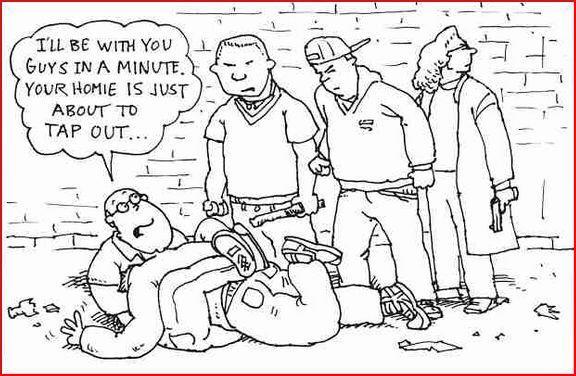
So instead of spending time learning intricate grappling techniques and submissions etc, learn take down defenses, and how to get back up QUICK, when you're on the ground. Focus on those elements of ground fighting, and you will be best prepared for the majority of street encounters you are likely to find yourself in, at least in the UK.  Your mileage may vary, but thats the situation where I live. 

Walk On! 

Wednesday, May 7, 2025

Cross training in other arts?

 In my previous post I wrote about the importance to look at the 'root', and not the branches.

Subscribers to the JKD concepts method tends to train in various martial arts, often combining the strengths of many into a personal expression of JKD (not Bruce Lee's ),and/or looking at similarities (but you'd then invariably need to know the original material too, that's a lot of time invested), whilst those on the other side of the fence focus on the fundamental material, (just learn to punch and kick etc etc.) and apply Bruce Lee's teachings on strategy and structure..  One trains the root, the other the branches (you should by now know which is which).

However, if you are on the 'original JKD' side of the fence, does it matter or is it even beneficial to train in other arts?  The answer is obviously not a one size fits all.  Firstly, you need to be mindful how you approach that training. Why are you cross training? Is it because you simply enjoy it, are you in to the sport element of the other art(s) perhaps? 

Me and one other student recently did a little of this. We went to a workshop hosted by a local kickboxing school, who had invited Bill 'Superfoot' Wallace to teach.  Truth be told, we went primarily to meet with this legend of the martial arts world, after all he's not getting any younger. (79 by the time of writing). 

That said, it was fun to spend about 2 hours training kick boxing combo's and techniques , predominantly his approach of course (and boy, does he love the side kick, we threw a lot of them).. But what did we learn from it?  

What stood out for me personally is that all drills we did, were aimed at the 'competition' strategies you may encounter. All kicks/punches were above the belt etc, so the structure/approach and execution of all we did was aimed at that.  If you have trained in JKD for a while, this should hopefully be immediately apparent.  Some of the combo's we trew, could be simplified if used on the street. (why bother trying to make the opponent move his arms so I can kick him in the ribs), when just as easily I could have kicked him in the knee or groin?   

Nevertheless there were some pointers for me personally that I found helpful. It is always good to have another person pick up on little habbits you may have (bad or good, but usually you want them to pick up on 'bad' stuff, that's how you learn and grow) and Bill found a few on me. 

Truth be told, I wasn't used to fight on barefeet (and I developed blisters about 15 minutes in that continued to distract me for the rest of the session), and I'm not used to a kick boxing approach so I naturally didn't perform certain techniques the way he wanted me to (muscle memory can be a dissadvantage sometimes, I wrote about that before..). Personally, I wasn't too happy with my personal performance, but that's OK, I picked up a few pointers and had a great time! 

My main focus will always be JKD, but it was fun to get some other insights and to learn how others approach a fight. You can get a lot from books and videos, but occasionally experiencing it helps further your understanding.  And in this case, if you can learn from a legend,  then take the opportunity if you can, it's fun!

Walk On! 

Monday, April 28, 2025

The style of no style, system without a system, what's all this about?

 Bruce Lee was a man seemingly contradicting himself.  On the one hand, he is known for remarks or quotes as those in the title, and actually named his personal art 'Jeet Kune Do' and if you know the translation / meaning it would appear to seeminly solidify it into a 'style'  on the otherhand, he advocated to go 'beyond style', or beyond system.

For us living in the 2020's, reading Bruce Lee's notes and articles about him, it is often a little difficult to understand, particularly if you do not know in what phase of his personal development he made such statements or notes, and if they were for himself or a certain audience.   All in all it hasn't helped in making things easy to understand.  If you read earlier notes or annecdotes by others who knew him, you'd be forgiven to think  that Bruce was on a path to gather the best of many styles, and put them together into one coherent system, but he soon discovered that various systems varied in their approach, and they just didn't work well (together), and he then  came to the realisation that he approached it all wrong. Instead of looking from outside in, he decided to look inside out. In other words, rather than looking at the branches (the various martial arts systems/styles out there), he looked at the root of all human combat, which is the way a human being moves-functions. No matter what art you take, there's a human at the core(root)! This is where his statement 'it is futile to look at all the decorative flowers and branches, if you understand the root, you understand all it's blossoming', originates. 

He then started approach martial arts scientifically, to focus on how humans moved, which movements were more efficient than others for a certain task etc. This allowed him to become efficient, and fast. 

Yes, he had 3 arts at the root of his development, but he had found that these already had a fair degree of scientific approach behind them, he only needed to refine and adapt them to his needs. These were chiefly Ving Tsun, Boxing and Fencing, and by doing so, they no longer were 'fencing (he used no bladed weapons), boxing (he didn't use gloves and his footwork resembled more that of a fencer), and the forms in ving tsun were no longer important, rather he used the theories of centreline, 4 corners and others etc to develop his strategies.  The useful elements of each of these 3 arts were modified to a degree to work seemlessly together, and elements of grappling arts were studied to cover the ground fighting aspect, but all whilst being very consious not to move from style to style, depending on the situation, but rather which action / human movement is the most efficient/direct/effective at any given moment.  He didn't throw a boxing punch, followed by a wingchun trap and a kick, he 'just punched', 'kicked' , 'grabbed', 'pulled', 'threw' as it came naturally, not labelling things any longer.  The movements were purely based on efficiency as performed by the human body, and as such he transcended systems/styles.  This is also where the statement comes from that Jeet Kune Do, trancends all styles. 

This is what the true art of Jeet Kune Do is all about.  It can still be called a style, but I hope that you understand that this is not a 'style' in the traditional sense, but the rather the style of human combative movement.

The label Jeet Kune Do serves this purpose to identify we're studying/practicing Bruce Lee's teachings, and not anyone elses.

Walk On!


Monday, April 14, 2025

Workshop announcement

 Ok, shamefull plug alert!  

Since 2018 I've had the pleasure to invite my instructors over for an annual JKD workshop. We only had to skip one year due to the pandemic, but this year they are back for the 6th time.

Here's the promo video, but if you want to join in the fun, don't delay and get in touch via our website contact page! 50 pounds per person for 4 hours of instruction if you use the early bird registration option. 


Walk On! 

Wednesday, March 26, 2025

I'm not getting any leaner!

You'll note that I deliberately didn't use the word weight above. (see my earlier article about weightloss March 2024).  We want to be leaner, look better/fitter, more ripped, however you'd like to put it.

Yes some weighloss might occur, but it depends how much you bulk up in muscle too, and all of this is of course dependent on your goals and on your approach. Muscle is denser (=heavier) than fat, so if you lose fat, but gain muscle, your weight might still go up, so use the mirror and clothing sizes to judge if you're going the right way. 

So lets say that isn't happening, there are multiple reasons why this might be the case, below a list of reasons, what you can do about it. And don't worry, it might just be temporary! 

1. Assess Your Current Approach:

Diet:
Calorie Deficit: Are you consistently consuming fewer calories than you burn?

Nutrient-Rich Foods: Focus on whole, unprocessed foods like fruits, vegetables, lean protein, and whole grains.

Portion Control: Be mindful of portion sizes to avoid overeating.

Mindful Eating: Pay attention to your hunger and fullness cues, and avoid distractions while eating.

Hydration: Drink plenty of water throughout the day.

Exercise:

Regular Activity: Aim for at least 150 minutes of moderate-intensity aerobic activity or 75 minutes of vigorous-intensity aerobic activity per week.

Variety: Incorporate different types of exercise, including cardio and strength training.

Increase Activity Throughout the Day: Walk more, take the stairs, and find opportunities to move more.

Sleep:

Prioritize Sleep: Aim for 7-9 hours of quality sleep per night.

Establish a Bedtime Routine: Wind down before bed to promote better sleep.

Stress:

Manage Stress: Find healthy ways to cope with stress, such as exercise, meditation, or spending time in nature.

Seek Support: Talk to a trusted friend, family member, or therapist if you're struggling with stress.

2. Potential Reasons for Fat Loss Resistance:

Medical Conditions: Certain medical conditions, like hypothyroidism, can make weight loss more difficult.

Medications: Some medications can cause weight gain as a side effect.

Hormonal Imbalances: Hormonal fluctuations, especially during menopause, can affect metabolism and weight/fat.

Genetics: Genetics can play a role in how your body stores fat and metabolizes calories.

Age: Metabolism naturally slows down with age, making it harder to lose fat.

Muscle Loss: As we age, we tend to lose muscle mass, which can further slow down metabolism.

Plateaus: It's common to experience weight loss plateaus, where progress stalls temporarily.

Not Enough Protein: Protein helps you feel full and can boost metabolism.

3. Seeking Professional Help:

Consult a Doctor:
Talk to your doctor to rule out any underlying medical conditions that might be hindering your weight loss efforts.

See a Registered Dietitian:
A registered dietitian can help you create a personalized meal plan that meets your individual needs and goals.

Consider a Fitness Professional:
A certified fitness professional can help you develop a safe and effective exercise program, if your JKD workouts are not enough. (review how often you practice, in class and in private). 

4. Additional Tips:

Set Realistic Goals: Don't expect overnight results. Focus on making sustainable changes to your lifestyle.

Be Patient and Persistent: Weight / fat loss takes time and effort. Don't get discouraged if you don't see results immediately.

Celebrate Small Wins: Acknowledge your progress, no matter how small, to stay motivated.

Focus on Health, Not Just Weight: Prioritize your overall health and well-being, not just the number on the scale.

Find a Support System: Surround yourself with people who are supportive of your goals.

Walk On!


Tuesday, March 11, 2025

Learning to swim

If you want to learn to swim, you have to get into the water. On dry land, no frame of mind is ever going to help you!  This was a statement often referred to by Bruce Lee. 

As with anything, if you want to learn something, you will have to start and actually do it! If you want to learn to fight, you need to get fighting! 

It's all great to study theory,  practice on focus gloves , heavy bags and pre-arranged drills, but until you add the 'non co-operative element' in your martial arts training (also known as your oponent who doesn't want to get hit, and worse, will hit back!) you're still more or less 'dry land swimming'.  

But how do you go about it? If you have a good teacher, they'll ensure that you gradually get introduced to it.  At first the water isn't too deep and you can easily reach the bottom, so to speak.  They'll get you sparring at a low intensity, and perhaps introduce some other restrictions so that you can get used to the pressure of the situation.  Perhaps there is a restriction on countering. A lot of beginners are hesitant to step forward and practice an attack, for fear to be running into a counter/hit, so the partner is restricted to evasion/parries etc, and you can take turns. After your attack, you 'reset' and let the other attack and take turns like that. This way you can gradually get used to both attacking as well as defending and reading the opponent, what are the tell tale signals that an attack is imminent? Is it a change in rhythm, a certain posturing, is there a slight hesitation just before, or do they have a habbit of 'chambering' their punches.. 

On the attacking side, what footwork helps you to get there and bridge the gap? What works for you, what didn't? Do you get out of breath, or are you easing into the situation and learn to 'relax', and keep a clear head, let go of all thoughts and tensions, and let nature take it's course. 

 If you can approach your sparring in that way, and not be concerned with winning or losing, you will start to grow in the game, which in turn will boost your confidence, get comfortable in the water, and keep on swimming.  

Walk On! 

Wednesday, February 12, 2025

Practice Makes Perfect

I know I'm stating the obvious here, but it is common sense, practice does make perfect. 

Drill something until it becomes second nature. Alternatively there's another other quote: an amateur practices until they get it right, a proffesional practices so that they never get it wrong..   

But you will have to know HOW TO do it right, otherwise you wouldn't know what to aim for! Lets just asume you've learned how to do it right (you've seen it demonstrated, have been taught etc.) how do you ensure that you get it right?  

First of , spend the time:  As with anything, it's easy to get carried away. Lets say you're practicing a punch on a heavy bag or similar target. After some time you might just be hitting the bag as it 'feels good', you're letting of some steam etc.. but did you lose good form?  If you did, then it's high time to take a step back, slow down, and if needed go to all the way back to slow motion to go through all the mechanics in detail, and slowly speed up again.  

The point is, if you're doing it wrong, and you don't know, or don't care, the risk is that you condition yourself for failure, it becomes a bad habit and very , very difficult to put right!  That punch becomes sloppy by nature, it won't have the correct allignment, you end up being telegraphic, it won't be power full, you risk injury (either by wrong execution, or by the fact your opponent saw you coming by a mile and beat you to it!) , it won't be as fast as it could be etc etc etc. 

So as soon as you sense you're starting to make mistakes, do yourself a favour, slow down and focus on correcting it or STOP, and focus on something esle for a while.

It might al seem so straightforward, but so many people don't do it, or don't realise they probably own one of the best tools to check yourself, a mobile phone! Film yourself, either in normal speed or if you really want to pick up on the finer details, go for slow motion capture.  What mistakes or habbits can you pick up on.  Did you 'set up' your moves with something preliminary, however small, is your footwork good or are you flat footed, do you drop your guard when punching, are you dropping your hand on recovery etc. etc. 

If you don't know, share the footage with someone, preferably with your instructor to see if they see anything and give you pointers to work on.  Take your training and practice sessions seriously, and you'll make great improvements soon enough! 

Walk On! 


Hand before Foot! Correct execution of the lead straight in Jeet Kune Do.

 On one of the several Facebook Jeet Kune Do group, there is currently a 'discussion' on hand before foot when punching. I put discu...